
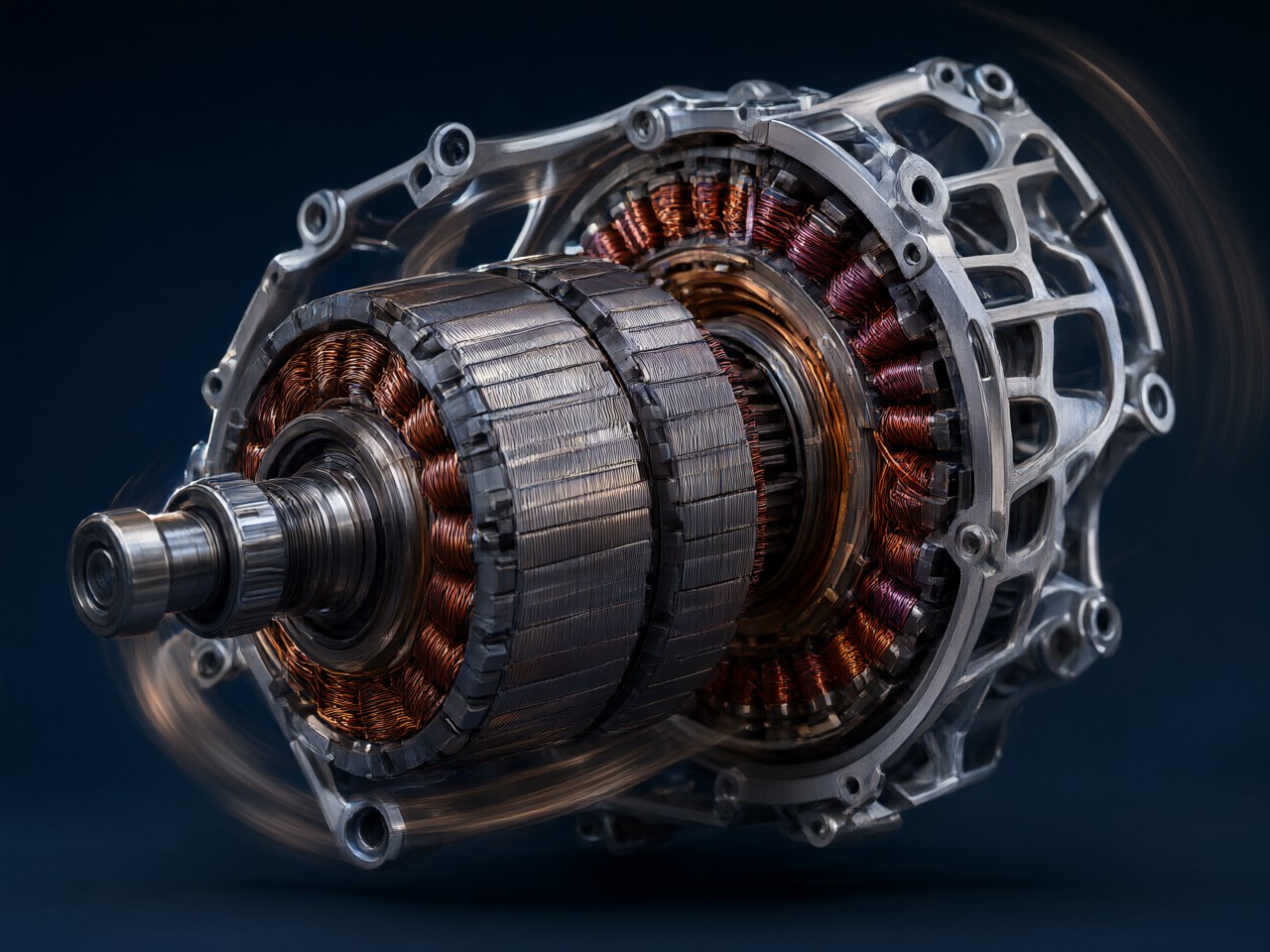
On November 5, German automotive supplier ZF officially launched the High Revolution Drive, a high-speed 3-in-1 electric drive system. Capable of reaching a maximum motor speed of 30,000 rpm and paired with a two-stage gear reducer with a ratio of approximately 18:1, the…
This article is reposted by Juncai Magnetic Applications, with all rights reserved by the original author; the original link is provided in the "Sources" section at the end.
On November 5, German automotive components giant ZF officially launched the High Revolution Drive, a high-speed 3-in-1 electric drive system. The motor in this solution can reach a maximum speed of 30,000 rpm. Paired with a two-stage gear reducer with a transmission ratio of approximately 18:1, it significantly compresses the volume of the motor and the entire e-drive system under the premise of unchanged output power, providing a new pathway for the lightweighting and cost reduction of passenger car e-drives.
According to ZF, compared to its existing 18,000 rpm SELECT e-drive product, the High Revolution Drive system reduces both volume and weight by nearly 25%, decreases the usage of permanent magnets by 50%, and maintains a system efficiency of close to 93%. The version unveiled this time has a peak power of 200 kW and a peak wheel torque of 3,500 Nm. It targets the mainstream 150-200 kW passenger car e-drive market and is compatible with both 400V and 800V voltage platforms. Currently, ZF is in commercial negotiations with several automakers and plans to achieve mass production by 2030.
The core logic of the high-speed solution relies on the matching relationship among motor power, speed, and torque. When power is fixed, increasing the speed can reduce the required output torque of the motor, thereby shrinking the motor's physical size. For permanent magnet synchronous motors, once the torque demand drops, the rotor can be designed to be smaller, directly reducing the amount of magnetic steel used. This 50% reduction in magnets is the result of comparison with the 18,000 rpm SELECT product under the same power conditions. The decrease in magnetic material consumption not only lowers material costs but also alleviates the e-drive industry's reliance on the supply chain of rare earth permanent magnet materials.
To ensure the driving torque at the wheel end, this solution adopts a large-ratio two-stage cylindrical gear reducer to amplify the output torque of the high-speed motor. The entire architecture redistributes the load division between the motor and the reducer: the motor focuses on high-speed output and bears the low-torque load, while the reducer is responsible for torque amplification. Ultimately, this achieves the 3-in-1 integration of the motor, inverter, and reducer, meeting the goals of lightweighting and miniaturization.
30,000 rpm is not an unlimited speed choice; behind it is a balance of multiple technical constraints. An increase in speed will simultaneously lead to a rise in rotor centrifugal stress, bearing operating conditions, gear meshing speed, NVH (Noise, Vibration, and Harshness), and the difficulty of electronic control. Under the same structural conditions, increasing the speed from 18,000 rpm to 30,000 rpm theoretically increases the rotor centrifugal stress to about 2.78 times the original level. The R&D team counteracts the risks by shrinking the rotor and optimizing structural and material solutions. At the same time, the higher input speed and large transmission ratio pose higher requirements for gear tooth profile, meshing accuracy, bearing support, and lubrication design. Thomas Meiser, head of ZF's e-mobility business, stated that during development, the motor, gears, bearings, and tooth profiles were matched as a holistic system, and 30,000 rpm is the optimal balance point considering both technical feasibility and economic viability.
It is reported that this product adopts ZF's existing hairpin flat-wire winding process, and gear machining can also reuse original production line equipment. The existing production lines can adapt to different motor diameters, axial lengths, and winding configurations without the need for large-scale new production line construction. This product belongs to the SELECT modular e-drive platform, inheriting the original technological accumulation in motors, inverters, and transmission systems.
ZF estimates that, under the premise of similar power and application scenarios, the High Revolution Drive may achieve a low double-digit percentage system price advantage compared to traditional solutions. The cost dividend comes from the reduction in magnetic materials, compact structure, and the reuse of existing production lines; while the increased costs of bearings, transmission, and NVH control brought by high speeds are also included in the comprehensive system consideration. The product positioning focuses on the 150-200 kW passenger car track. In this power range, the combination of a high-speed motor and a two-stage reducer can achieve a balance among vehicle packaging space, material consumption, manufacturing costs, and operational efficiency.
Sources
- EET China (2026-11-09)
- Original link: ZF Launches 30,000 rpm High-Speed Electric Drive
- https://www.eet-china.com/mp/a538090.html