
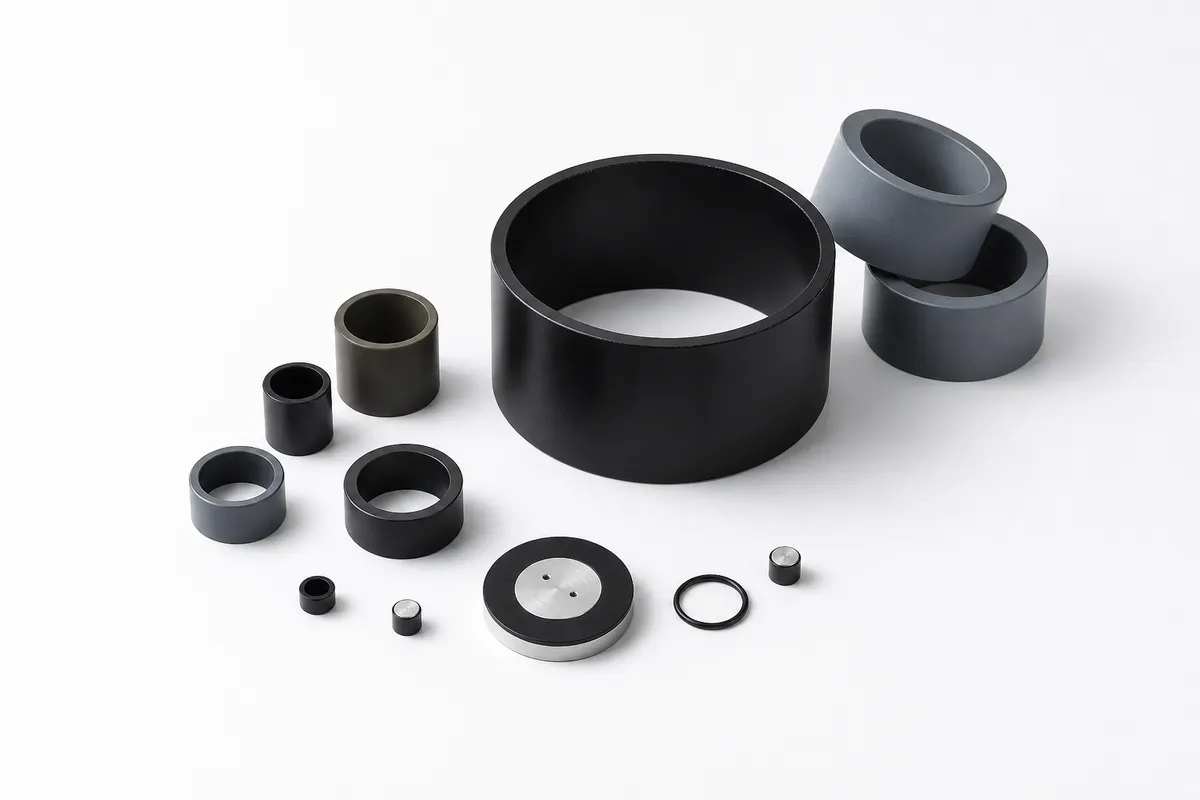
Hot-pressed NdFeB Magnet
热压钕铁硼(NdFeB)磁体
Hot-pressed NdFeB radial rings are anisotropic rings formed by high-temperature compaction and extrusion of rapid-quenched NdFeB magnetic powder.
They achieve high magnetic energy product while maintaining strong coercivity, making them ideal for compact, high-torque motor applications. Radial orientation allows single-pole, multi-pole, and skewed magnetization patterns with uniform magnetic properties and minimal non-magnetic zones for smoother, quieter torque output.
Rings can be magnetized via coils without splicing — simple installation, high precision, and excellent batch-to-batch consistency.
Key Features
High Performance
High (BH)max with strong coercivity — ideal for small-volume, high-torque motors.
Radial Orientation
Magnetized in any radial direction: single-pole, multi-pole, or skewed pole patterns.
Uniform Field
Consistent magnetic properties and small non-magnetic zones for smooth, quiet torque.
Easy Assembly
Coil magnetization without splicing — precise fit and excellent consistency.
Ring Structure
- ConstructionOne-piece sintered ring — no glued arc segments
- OrientationRadial anisotropy across the full circumference
- Field profileNear-sinusoidal Br for low cogging & quiet running
Production Process
A 12-step route from rapid-quenched powder to a magnetized, inspected ring.
- 1Rapid-quenching
- 2Powder mixing
- 3Pressing GHM I (room temp.)
- 4Pressing GHM II (medium temp.)
- 5Pressing GHM III (high temp.)
- 6GHM3 blank
- 7Trim top & bottom
- 8Machine I.D. / O.D.
- 9Coating (spray / electrodeposition)
- 10Magnetizing
- 11OQC inspection
- 12Packaging
Magnetization Methods
Hot-pressed NdFeB rings can be magnetized with any number of poles in the radial direction, including oblique (skewed) pole patterns.
Skewed multi-pole
Diagonal pole arrangement along the axis to reduce cogging torque.
Multi-pole (O.D. / I.D.)
Alternating N/S poles distributed around the circumference.
Radial orientation
Single radial pole pair — N on O.D., S on I.D.
Uniform Field Distribution
Continuous radial orientation yields a near-sinusoidal surface field with small non-magnetic transition zones — the key to smooth, quiet motor torque.
Typical Applications
Magnetic Grades
Typical values at room temperature, sourced from the AIC Hot-Pressed NdFeB performance data sheet. Full GHM series — anisotropic GHM-40R to GHM-39UHR and isotropic GHM-17R to GHM-14UHR rings. Recoil permeability μr ≈ 1.05 for anisotropic grades.
| Grade | Remanence Br (T) | Coercivity Hcb (kA/m) | Intrinsic Hcj (kA/m) | (BH)max (kJ/m³) | Density (g/cm³) |
|---|---|---|---|---|---|
| Anisotropic rings | |||||
| GHM-40R | 1.26–1.33 | ≥ 885 | ≥ 1040 | 300–335 | 7.55 |
| GHM-43R | 1.29–1.36 | ≥ 890 | ≥ 915 | 320–350 | 7.55 |
| GHM-48R | 1.38–1.44 | ≥ 795 | ≥ 835 | 360–395 | 7.55 |
| GHM-32HR | 1.12–1.22 | ≥ 805 | ≥ 1190 | 240–270 | 7.55 |
| GHM-36HR | 1.20–1.28 | ≥ 860 | ≥ 1160 | 270–300 | 7.55 |
| GHM-40HR | 1.25–1.34 | ≥ 885 | ≥ 1120 | 295–335 | 7.55 |
| GHM-44HR | 1.32–1.38 | ≥ 940 | ≥ 1080 | 335–360 | 7.55 |
| GHM-31SHR | 1.10–1.19 | ≥ 815 | ≥ 1600 | 230–265 | 7.60 |
| GHM-35SHR | 1.18–1.26 | ≥ 880 | ≥ 1510 | 265–295 | 7.60 |
| GHM-39SHR | 1.25–1.32 | ≥ 950 | ≥ 1440 | 295–325 | 7.60 |
| GHM-42SHR | 1.28–1.35 | ≥ 970 | ≥ 1350 | 310–345 | 7.60 |
| GHM-39UHR | 1.25–1.32 | ≥ 950 | ≥ 1680 | 295–325 | 7.60 |
| Isotropic rings | |||||
| GHM-17R | 0.85–0.91 | ≥ 575 | ≥ 1120 | 125–145 | 7.55 |
| GHM-16HR | 0.82–0.88 | ≥ 560 | ≥ 1280 | 120–135 | 7.55 |
| GHM-16SHR | 0.80–0.86 | ≥ 565 | ≥ 1590 | 115–135 | 7.60 |
| GHM-14UHR | 0.76–0.81 | ≥ 525 | ≥ 1750 | 95–125 | 7.60 |
Product Manual
Hot-pressed NdFeB Magnet Product Manualhot-pressed-ndfeb-magnet.pdfDownload PDFFrequently Asked Questions
Answers to common questions about our magnets, customisation, ordering and shipping.
- What is a hot-pressed NdFeB magnet? +
- Hot-pressed NdFeB (also hot-deformed) is produced by hot pressing/deformation of rapidly quenched NdFeB ribbon into fully dense anisotropic magnets with high energy product without heavy rare-earth additions.
- What are the advantages of hot-pressed NdFeB? +
- It achieves high magnetic strength (comparable to sintered) with fine grain structure, excellent corrosion resistance, and reduced heavy-rare-earth (Dy/Tb) usage, suitable for high-efficiency motors.
- Is hot-pressed NdFeB suitable for high-temperature motors? +
- Yes. Its fine-grain anisotropic structure gives high coercivity and temperature stability, making it well suited for EV traction and servo motors where demagnetisation resistance at elevated temperature is critical.
Need a Custom Ring?
We can tailor grade, dimensions, pole count, skew angle, and coating to your motor design — contact our engineering team for samples and DFM support.
Discuss Custom Requirements