

Molded NdFeB Magnet
模压钕铁硼磁体
Molded NdFeB — also known as compression-moulded bonded NdFeB — is a rubber- or epoxy-bonded permanent magnet made by compacting rapid-quenched NdFeB powder with a binder under high pressure, then curing. It delivers high magnetic energy product without sintering, while allowing near-net-shape forming of complex geometries that would be costly or impossible to machine from sintered NdFeB.
AIC Engineering supplies the GPM series from GPM-2 up to GPM-13L — 13 standard grades with published ranges plus variants with measured curves — covering max energy product up to 104 kJ/m³ and max operating temperature up to 180 °C. The high-coercivity grades GPM-8H (Hcj 1040–1360 kA/m) and GPM-8SR (800–1120 kA/m) are rated to 180 °C for elevated-temperature motor and sensor applications; GPM-10H (Hcj 720–840 kA/m) and GPM-12H (720–800 kA/m) are rated to 160 °C.
Because parts are pressed to shape and cured — not cut from a sintered block — molded NdFeB is dimensionally precise, free of machining cracks, and economical in volume. The compound is corrosion-resistant and temperature-stable, making it suitable for electronic devices, automotive components, and medical equipment.
Key Features
Near-Net-Shape Moulding
Pressed to final dimensions — no machining, no cracking, low waste, tight batch consistency.
Up to 104 kJ/m³ (BH)max
Highest energy product of any bonded NdFeB form — roughly a third of a common sintered grade such as N35, traded for near-net-shape moulding.
High-Temp Grades to 180 °C
GPM-8H (Hcj 1040–1360 kA/m) and GPM-8SR (800–1120 kA/m) for elevated-temperature service.
Complex Geometries
Thin walls, arcs, rings, and insert-moulded assemblies — shapes that sintered NdFeB cannot deliver.
Magnetic Grades
Typical values at room temperature, sourced from the AIC Bonded NdFeB performance data sheet. 13 standard GPM grades — GPM-2 / 4 / 6 / 8 / 8L / 8H / 8SR / 10 / 10H / 12 / 12H / 12L / 13L. Measured curves for these and 12 further variants are on the demagnetization curves page (preview below).
| Grade | Remanence Br (mT) | Coercivity Hcb (kA/m) | Intrinsic Hcj (kA/m) | (BH)max (kJ/m³) | Max Op. Temp. (°C) |
|---|---|---|---|---|---|
| GPM-2 | 250–450 | 160–280 | 320–560 | 12–32 | 120 |
| GPM-4 | 400–550 | 240–360 | 400–640 | 32–52 | 120 |
| GPM-6 | 500–650 | 320–400 | 480–720 | 48–60 | 150 |
| GPM-8 | 600–680 | 360–440 | 640–800 | 60–72 | 160 |
| GPM-8L | 620–700 | 400–480 | 640–800 | 64–80 | 160 |
| GPM-8H | 600–660 | 400–480 | 1040–1360 | 64–72 | 180 |
| GPM-8SR | 620–700 | 400–480 | 800–1120 | 68–80 | 180 |
| GPM-10 | 680–730 | 400–480 | 640–800 | 76–84 | 160 |
| GPM-10H | 700–750 | 440–520 | 720–840 | 80–88 | 160 |
| GPM-12 | 720–770 | 440–520 | 720–800 | 88–96 | 160 |
| GPM-12H | 740–800 | 440–520 | 720–800 | 88–96 | 160 |
| GPM-12L | 750–800 | 400–480 | 480–640 | 88–96 | 150 |
| GPM-13L | 760–830 | 400–480 | 480–640 | 88–104 | 150 |
Recoil permeability μrec ≈ 1.15–1.22. Temperature coefficient of Br: −0.10 to −0.24 %/°C (grade dependent). Density: 4.8–6.4 g/cm³ (grade dependent). Saturation magnetizing force ≥ 1200–2400 kA/m. ● marks the high-coercivity grades rated to 180 °C.
Measured Demagnetization Curves
Hysteresisgraph test reports of 25 GPM grades, from GPM-2 to GPM-13L, including variants not yet in the grade table above. Single-sample test results, not guaranteed minimums.
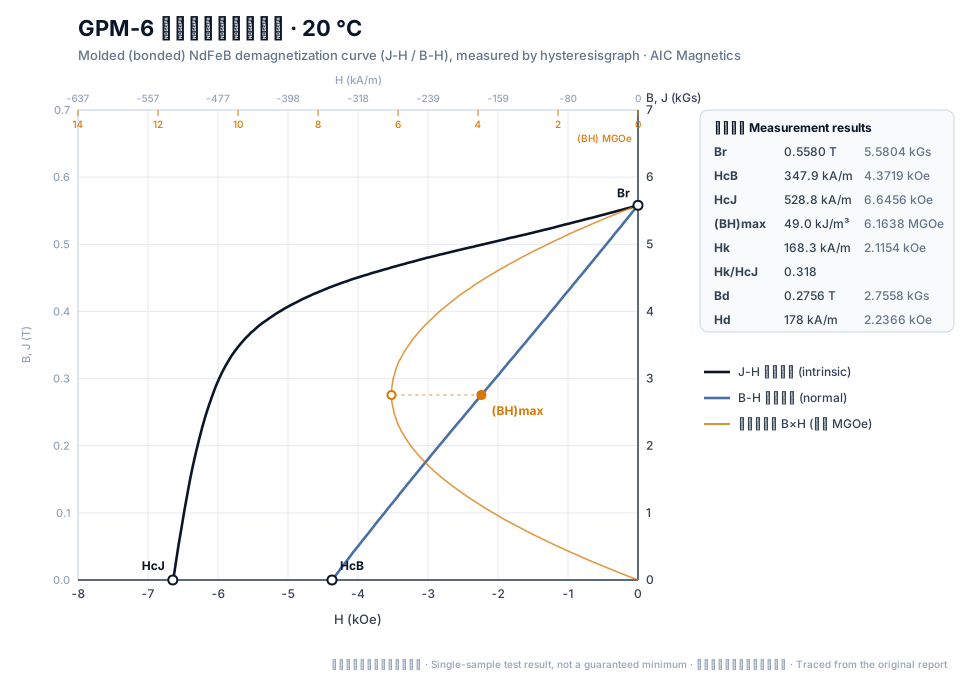
GPM-6
Br 0.558 T · HcJ 529 kA/m · (BH)max 49 kJ/m³
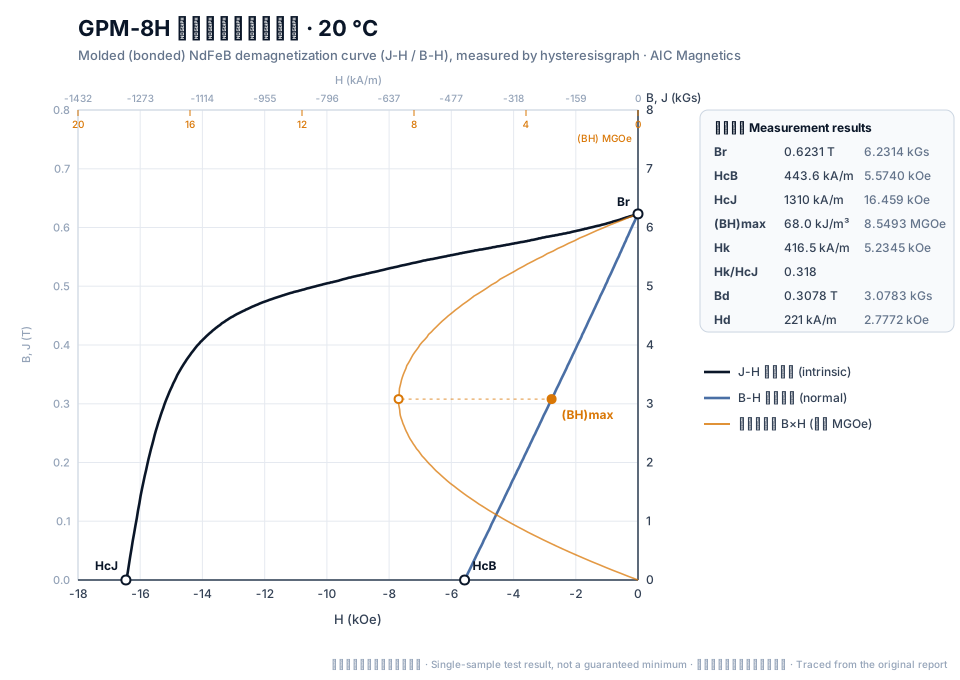
GPM-8H
Br 0.623 T · HcJ 1310 kA/m · (BH)max 68 kJ/m³
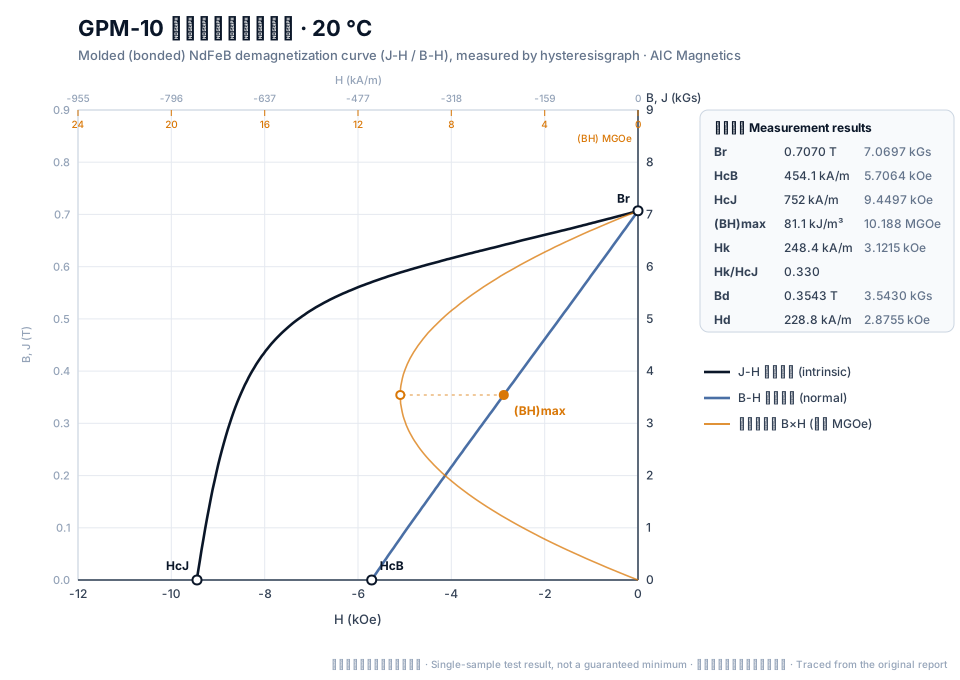
GPM-10
Br 0.707 T · HcJ 752 kA/m · (BH)max 81.1 kJ/m³
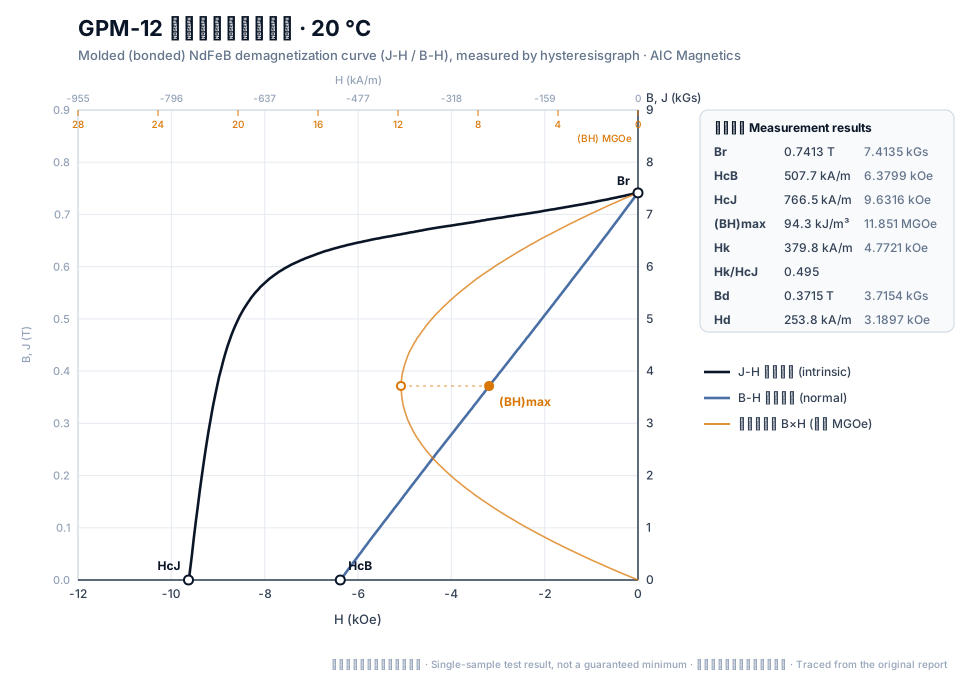
GPM-12
Br 0.741 T · HcJ 766 kA/m · (BH)max 94.3 kJ/m³
Compression-Moulding Process
From rapid-quenched powder to net-shape magnetized parts — no sintering, no machining waste.
- Rapid-quench NdFeB powder (MQ)
- Epoxy / resin binder mixing
- Granulation & flow-additive dosing
- Magnetic-field alignment option
- Precision die compaction (high pressure)
- Green-part dimension inspection
- Thermal cure (150–180 °C)
- Density & bond-strength check
- Surface coating (epoxy / e-coat / Ni)
- Pulse magnetizing to design direction
- 100% flux & dimension inspection
- Tray / tape packaging
Available Forms
Rings
O.D. 3–60 mm · wall ≥ 0.6 mm · radial or axial magnetization
Blocks & Tiles
Up to 50 × 50 × 25 mm · tight dimensional tolerance
Arc Segments
Motor rotors — custom R & pole angle
Insert-Moulded Parts
Metal / plastic shafts moulded in — single-piece assembly
Thin-Wall Cylinders
Wall down to 0.6 mm — sensors and encoders
Custom Profiles
From drawing · no machining required
Typical Applications
Need a Custom Molded NdFeB Part?
Send your drawing or sample — our engineers will confirm grade (GPM series), dimensions, magnetization, coating, and insert-moulding for your application. Samples and DFM support available.
Discuss Custom RequirementsProduct Manual
Molded NdFeB Magnet Product Manualmolded-ndfeb-magnet.pdfDownload PDFFrequently Asked Questions
Answers to common questions about our magnets, customisation, ordering and shipping.
- What is a molded NdFeB magnet? +
- Molded NdFeB — also called compression-moulded bonded NdFeB — is a permanent magnet made by compacting rapid-quenched NdFeB powder with a rubber or epoxy binder under high pressure, then thermal-curing. No sintering is needed, and parts are pressed near-net-shape so they are dimensionally precise and free of machining cracks.
- How strong is molded NdFeB compared with other bonded forms? +
- It has the highest energy product of any bonded NdFeB form — the AIC GPM series reaches (BH)max up to 104 kJ/m³ (GPM-13L, top of its typical range) across GPM-2 to GPM-13L. That is roughly a third of a common sintered grade such as N35 (about 280 kJ/m³) — the trade-off for the shape freedom of a bonded magnet.
- What is the maximum operating temperature of molded NdFeB? +
- Up to 180 °C for the high-coercivity grades GPM-8H (Hcj 1040–1360 kA/m) and GPM-8SR (800–1120 kA/m), used in elevated-temperature motors and sensors. GPM-10H (Hcj 720–840 kA/m) and GPM-12H (720–800 kA/m) are rated to 160 °C, and the standard grades to 120–160 °C.
- What shapes can molded NdFeB produce? +
- Rings (O.D. 3–60 mm, wall ≥ 0.6 mm), blocks and tiles, arc segments for motor rotors, insert-moulded parts with metal/plastic shafts, and thin-wall cylinders for sensors and encoders — all pressed to shape with minimal post-machining.